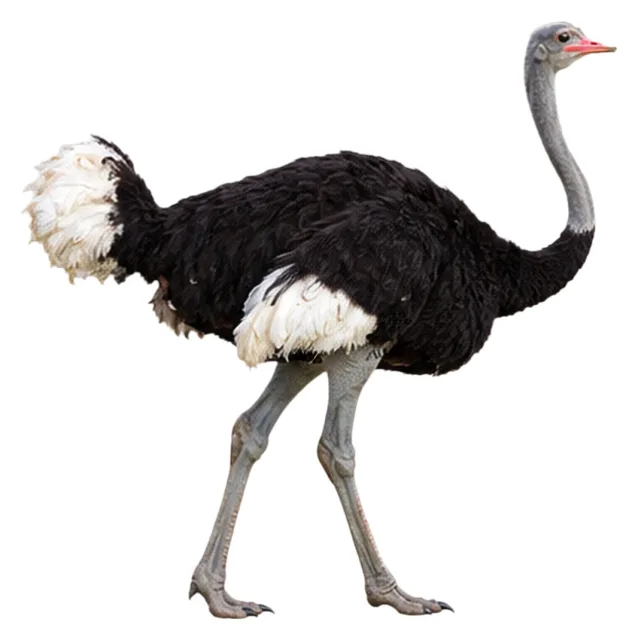
Common Ostrich
Common Ostrich · BirdGacha
1 / 11068
Illustration · not to scale
- Body Mass
- 111 kg
- Diet
- Omnivorous
- Migration
- Resident
⚔️ Ecological Combat Rationale
Heavy terrestrial build driving tremendous kick force with massive spiked claws, delivering bone-crushing forward impacts (ATK 256).
Dense skeletal mass and substantial frame affording formidable physical resilience against savanna and pampas predators (DEF 990).
* These descriptions interpret game abilities, not measured physical strength. Generated scores use body mass, rarity and balancing rules; legacy cards retain manual values.
How to identify
Begin with its tall body, long neck and powerful legs; this flightless bird lives on the ground.
Similar species
Species-specific comparison notes are not yet available. Related birds below are not necessarily lookalikes.
Calls & songs
A playable recording is not currently available for this species.
🌍 Range & Habitat
4 · Subspecies & regional ranges
- Struthio camelus syriacus · Extinct
Syrian and Arabian deserts
- Struthio camelus camelus
s Morocco and Mauritania to s Egypt, Eritrea and n, w Ethiopia, s to Cameroon and n Uganda
- Struthio camelus massaicus
s Kenya and c Tanzania
- Struthio camelus australis
s Africa
Frequently asked questions
What is its scientific name?
Struthio camelus
Which family does it belong to?
Ostriches (Struthionidae)
Where is it found?
Africa: Western & Central & Eastern & Southwestern
Sources & credits
📖 Open Full Article on Wikipedia- IOC World Bird List 15.2 ↗
- AVONET ↗
- Bird illustration credits ↗ · huashu-bird-sticker · PolyForm-Shield-1.0.0
- Illustration reference ↗ · tlim · Not recorded
Field identification notes
Common Ostrich field notes: terrestrial build, adult plumage and open habitats.
- Identification
- Begin with its tall body, long neck and powerful legs; this flightless bird lives on the ground.
- Where to look
- Natural habitats include African savannas and the semi-arid Sahel.
- Comparison points
- Adult males are dark while females are generally brown; do not automatically treat that difference as another species.
- Observation tip
- Observe feeding and walking from a distance. Its legs are defensive weapons, so avoid approaching or cornering it.
Compare another species: Somali Ostrich
Source checked 2026-11-02: The Maryland Zoo · Common Ostrich. Regional observations in the source are not global population assessments.