BIRDGACHA / FIELD NOTES
Rockjumpers
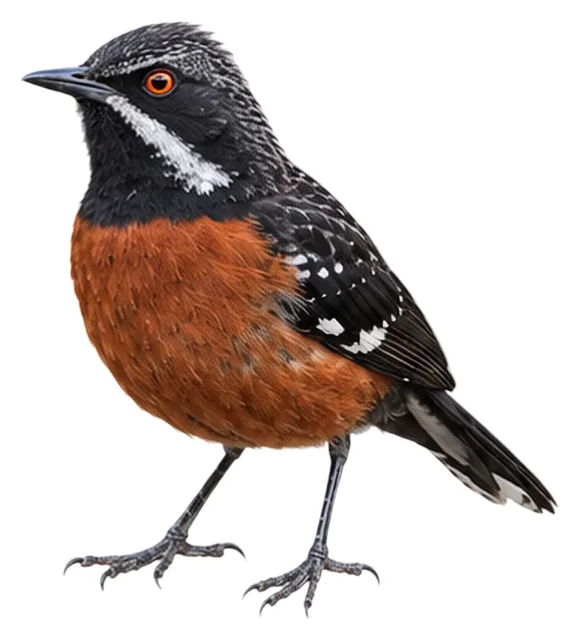
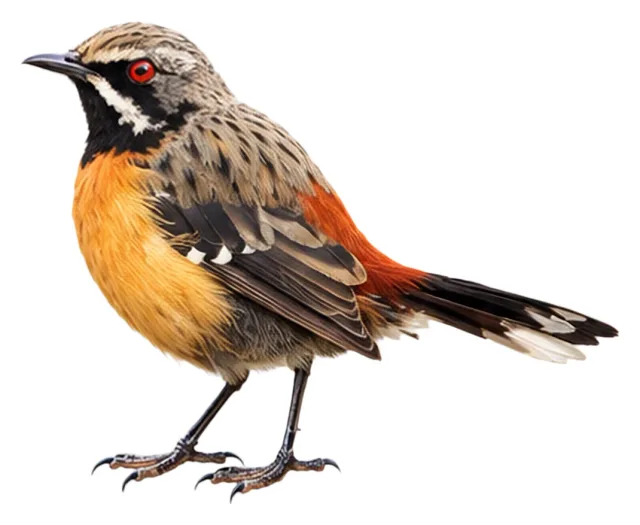
Rockjumpers are robust ground-oriented songbirds with long tails, strong legs and boldly patterned heads. Dark facial areas, pale markings and warm underpart colours vary between the two species and between sexes, while their bounding movements over rocks are conspicuous. The two species in this catalogue are Cape Rockjumper (Chaetops frenatus) and Drakensberg Rockjumper (Chaetops aurantius). They search rocky ground and adjacent vegetation for invertebrates, often remaining close to broken terrain and low cover. Compare the face and underparts while keeping the Cape and Drakensberg ranges clearly separated.
How to recognize Rockjumpers
- Look for strong legs and bounding movement between rocks.
- Compare the dark face, pale head stripes and underpart colours.
- Check Cape mountains versus the Drakensberg before naming a species.
Where they live
The family occurs in southern Africa, in the Cape mountains and the Drakensberg region. Rocky mountain slopes, boulder fields and associated low vegetation provide the characteristic setting. Cape birds use mountain fynbos, whereas the Drakensberg species occupies highland grassland and rocky terrain farther east, making geography a particularly useful identification clue. A rocky landscape alone is insufficient: the mountain region and vegetation help decide which of the two species is possible.
Species accounts: Cape Rockjumper · Drakensberg Rockjumper
Sources — natural history: BirdLife South Africa: Cape Rockjumper · Cornell Birds of the World: Cape Rockjumper (Chaetops frenatus), species natural history.
Classification: IOC World Bird List: family names and classification.
Some Cornell Birds of the World account sections require a subscription.
Updated 2026-11-06. Species counts follow this site's catalogue. This is an editorial summary, not an expert peer review.
Species records retain their original English, Chinese and scientific names.
2 results · page 1 of 1