BIRDGACHA / FIELD NOTES
Boatbills
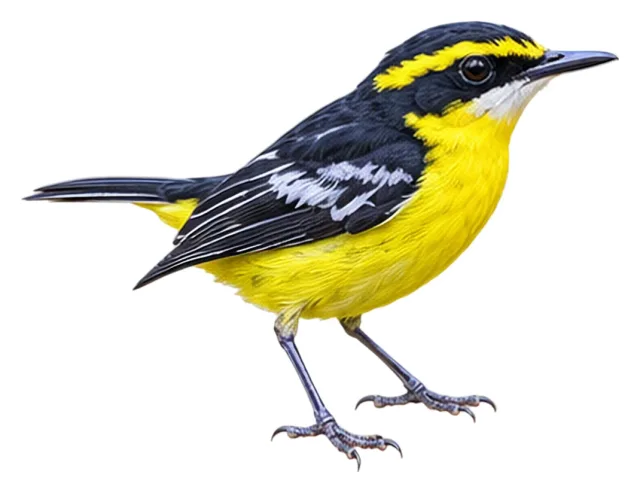
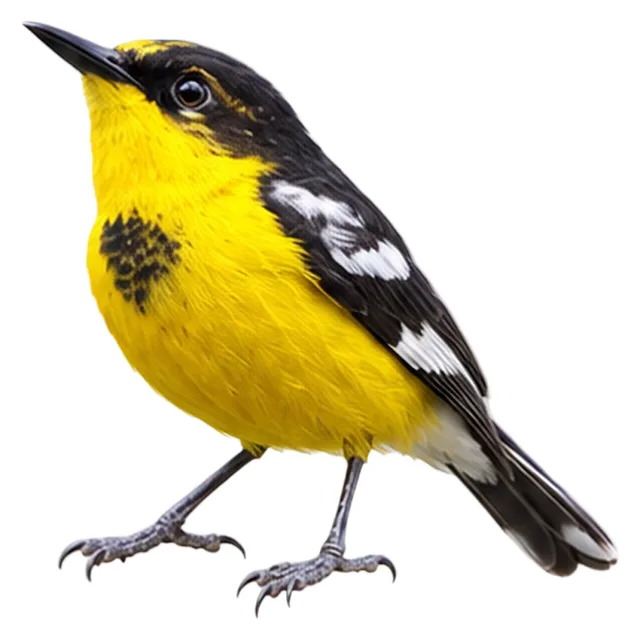
Boatbills have unusually broad, flattened bills, yellow underparts and contrasting dark upperparts. Their small bodies and active movements can recall flycatchers, but they often perch more horizontally and may cock the tail. The two species in this catalogue are Yellow-breasted Boatbill (Machaerirhynchus flaviventer) and Black-breasted Boatbill (Machaerirhynchus nigripectus). They take insects from foliage and also make brief catching flights or hover near leaves. A broad bill is most evident in an oblique or frontal view, while the dark breast pattern helps distinguish the two species. Calling birds can remain concealed in the middle layers of rainforest.
How to recognize Boatbills
- Bill: broad flattened bills.
- Outline: small bodies and often cocked tails.
- Feeding: gleaning insects and making short sallies.
Where they live
New Guinea, neighbouring islands and northeastern Australia contain the family's rainforest range. Yellow-breasted Boatbills use lower-elevation forest in parts of this region, while Black-breasted Boatbills are associated with New Guinea's mountain forests. Birds move through shaded foliage singly or in pairs rather than hunting exclusively from isolated open perches. Forest structure and elevation therefore provide useful context when interpreting a brief view of a yellow bird.
Species accounts: Yellow-breasted Boatbill · Black-breasted Boatbill
Sources — natural history: Wikipedia: Boatbills natural history · Cornell Birds of the World: Yellow-breasted Boatbill species account · Don Roberson: Boatbills field observations and natural history.
Classification: IOC World Bird List: family names and classification.
Some Cornell Birds of the World account sections require a subscription.
Updated 2026-11-06. Species counts follow this site's catalogue. This is an editorial summary, not an expert peer review.
Species records retain their original English, Chinese and scientific names.
2 results · page 1 of 1