BIRDGACHA / FIELD NOTES
Sharpbill & relatives
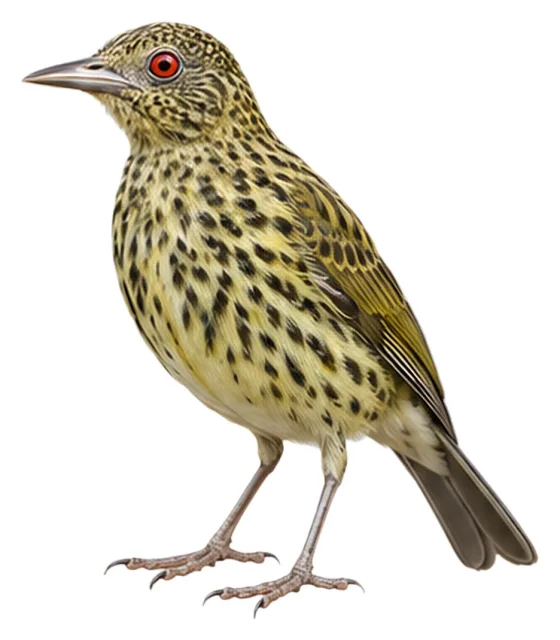
The Sharpbill has a distinctive tapered bill, greenish upperparts and pale underparts marked with dark spots. A coloured crown patch is usually concealed, making it less useful than the bill and spotted body in ordinary views. The species in this catalogue is Sharpbill (Oxyruncus cristatus). It takes fruit and small animal prey and can probe among tightly packed vegetation. Males give high, unusual vocalisations during display. The bird's scattered populations and unobtrusive feeding behaviour can make it difficult to encounter, despite its fairly distinctive combination of structure, pattern and voice.
How to recognize Sharpbill & relatives
- Bill: a sharply pointed bill.
- Outline: a compact greenish body with spotted underparts.
- Feeding: taking fruit and probing vegetation for small prey.
Where they live
Humid forests in scattered parts of Central and South America contain Sharpbill populations. It often uses forest canopy and foothill or mountain settings, though local elevation varies. Fruiting trees and vegetation holding concealed invertebrates offer different feeding opportunities. Its distribution is notably discontinuous, so a broad map spanning the American tropics should not be read as evidence that the bird occupies every intervening forest or every elevation within a region.
Species account: Sharpbill
Sources — natural history: Wikipedia: Sharpbill & relatives natural history · Cornell Birds of the World: Sharpbill species account · Don Roberson: Sharpbill & relatives field observations and natural history.
Classification: IOC World Bird List: family names and classification.
Some Cornell Birds of the World account sections require a subscription.
Updated 2026-11-06. Species counts follow this site's catalogue. This is an editorial summary, not an expert peer review.
Species records retain their original English, Chinese and scientific names.
1 result · page 1 of 1