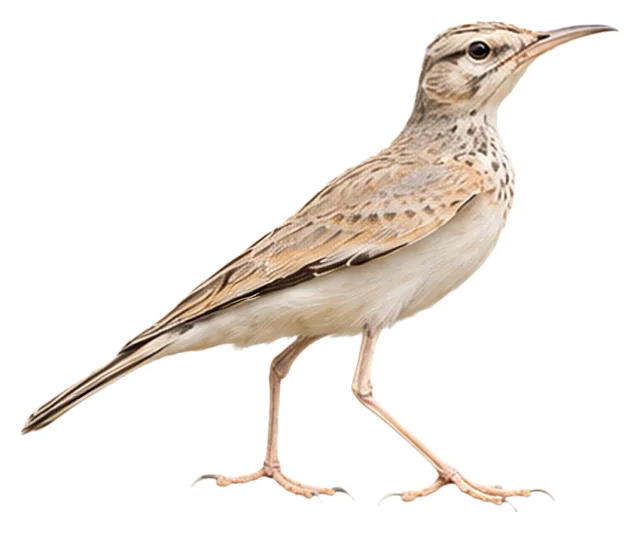
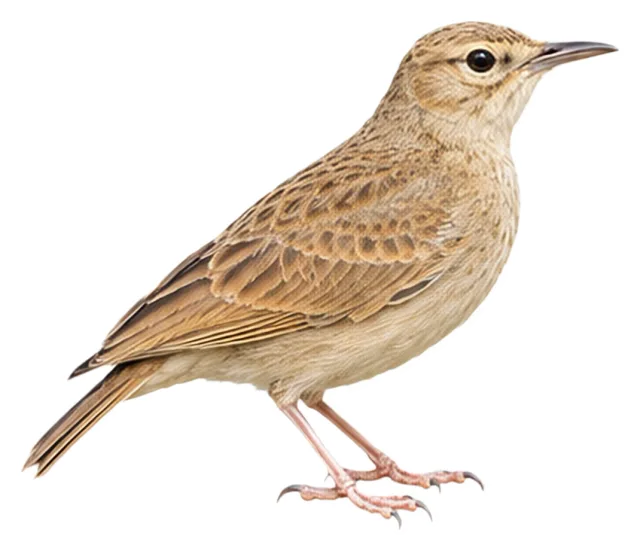
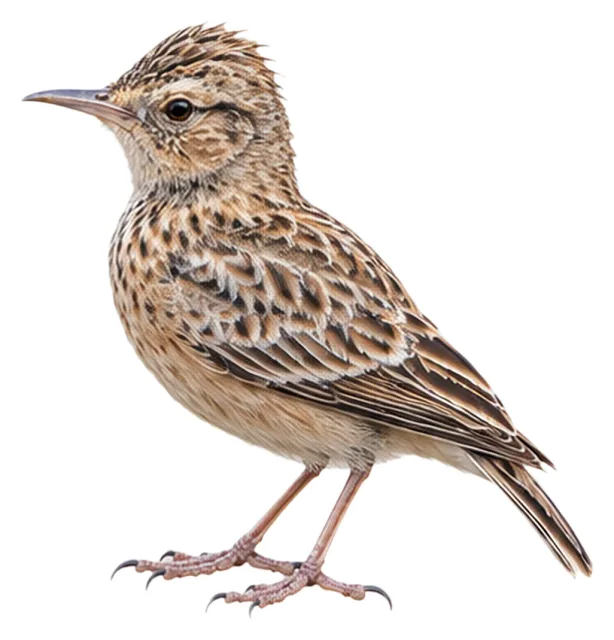
Greater Short-toed Lark
Greater Short-toed Lark · BirdGacha
7245 / 11068
Illustration · not to scale
- Body Mass
- 21.1 g
- Diet
- Omnivorous
- Migration
- Partially migratory
⚔️ Ecological Combat Rationale
Ecomorphologically adapted beak and agile strike momentum tailored to its foraging competition niche (ATK 94).
Lightweight agility and protective plumage camouflage favoring rapid evasive maneuverability over raw armor (DEF 62).
* These descriptions interpret game abilities, not measured physical strength. Generated scores use body mass, rarity and balancing rules; legacy cards retain manual values.
How to identify
Detailed field marks are not yet available. Use the linked sources to confirm an identification.
Similar species
Species-specific comparison notes are not yet available. Related birds below are not necessarily lookalikes.
Calls & songs
Milan Ruzic · Sources & credits
🌍 Range & Habitat
8 · Subspecies & regional ranges
- Calandrella brachydactyla brachydactyla
s Europe and Mediterranean islands, nw Africa?
- Calandrella brachydactyla hungarica
Hungary and n Serbia
- Calandrella brachydactyla rubiginosa
n Africa
- Calandrella brachydactyla hermonensis
s Turkey and Syria to ne Egypt
- Calandrella brachydactyla woltersi
s Turkey and nw Syria
- Calandrella brachydactyla artemisiana
c Turkey and Transcaucasia to nw Iran
- Calandrella brachydactyla longipennis
Ukraine and s Russia to sc Siberia and s Mongolia
- Calandrella brachydactyla orientalis
c Siberia, n Mongolia and n China
Frequently asked questions
What is its scientific name?
Calandrella brachydactyla
Which family does it belong to?
Larks (Alaudidae)
Where is it found?
Palearctic: Central & Southern
Sources & credits
📖 Open Full Article on Wikipedia- IOC World Bird List 15.2 ↗
- AVONET ↗
- Bird illustration credits ↗ · huashu-bird-sticker · PolyForm-Shield-1.0.0
- Illustration reference ↗ · rvorob1899 · CC BY-NC