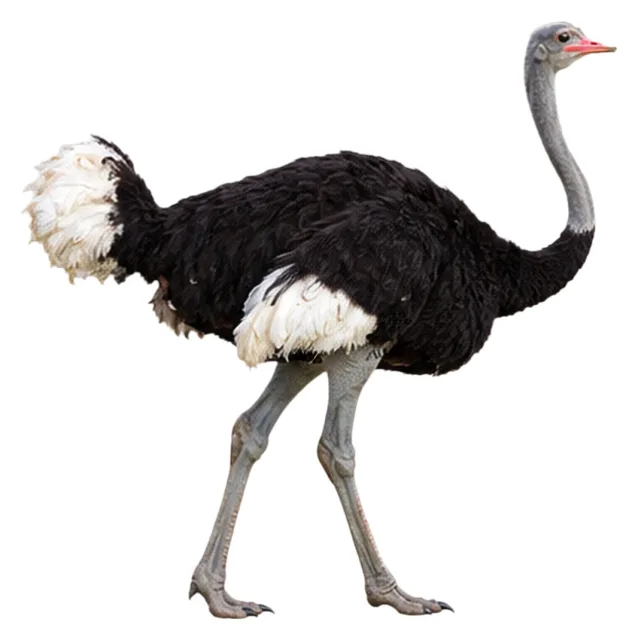
Strauß
- Körpergewicht
- 111 kg
- Nahrung
- Allesfresser
- Zugverhalten
- Standvogel
⚔️ Ökologische Kampfkraft-Analyse
Schwere terrestrische Statur mit enormer Trittkraft und mächtigen Klauen für verheerende Vorwärtsstöße (ANG 256).
Dichte Skelettstruktur und beträchtliche Masse für herausragende Widerstandskraft gegen Raubtiere der Savanne und Pampas (VER 990).
* Die Texte erläutern Spielfähigkeiten, keine gemessene Körperkraft. Generierte Werte nutzen Körpermasse, Seltenheit und Balanceregeln; ursprüngliche Karten behalten manuelle Werte.
Erkennungsmerkmale
Begin with its tall body, long neck and powerful legs; this flightless bird lives on the ground.
Ähnliche Arten
Artspezifische Vergleiche fehlen noch. Verwandte Vögel sehen nicht zwingend ähnlich aus.
Rufe & Gesang
Für diese Art ist derzeit keine Aufnahme verfügbar.
🌍 Verbreitung & Lebensraum
4 · Unterarten & Verbreitung
- Struthio camelus syriacus · Ausgestorben
Syrian and Arabian deserts
- Struthio camelus camelus
s Morocco and Mauritania to s Egypt, Eritrea and n, w Ethiopia, s to Cameroon and n Uganda
- Struthio camelus massaicus
s Kenya and c Tanzania
- Struthio camelus australis
s Africa
Häufige Fragen
Wie lautet der wissenschaftliche Name?
Struthio camelus
Zu welcher Familie gehört die Art?
Ostriches (Struthionidae)
Wo kommt sie vor?
Africa: Western & Central & Eastern & Southwestern
Quellen & Nachweise
📖 Vollständigen Wikipedia-Artikel lesen- IOC World Bird List 15.2 ↗
- AVONET ↗
- Illustrationsnachweis ↗ · huashu-bird-sticker · PolyForm-Shield-1.0.0
- Illustrationsvorlage ↗ · tlim · Not recorded
Field identification notes
Common Ostrich field notes: terrestrial build, adult plumage and open habitats.
- Identification
- Begin with its tall body, long neck and powerful legs; this flightless bird lives on the ground.
- Where to look
- Natural habitats include African savannas and the semi-arid Sahel.
- Comparison points
- Adult males are dark while females are generally brown; do not automatically treat that difference as another species.
- Observation tip
- Observe feeding and walking from a distance. Its legs are defensive weapons, so avoid approaching or cornering it.
Compare another species: Somalistrauß
Source checked 2026-11-02: The Maryland Zoo · Common Ostrich. Regional observations in the source are not global population assessments.